Wed Nov 18 2026
Motorcycle Shop Customer Retention: Know Who's Gone Quiet
Motorcycle shop customer retention starts with knowing who's overdue and who went quiet. Simple ways to get service customers back, with or without tools.
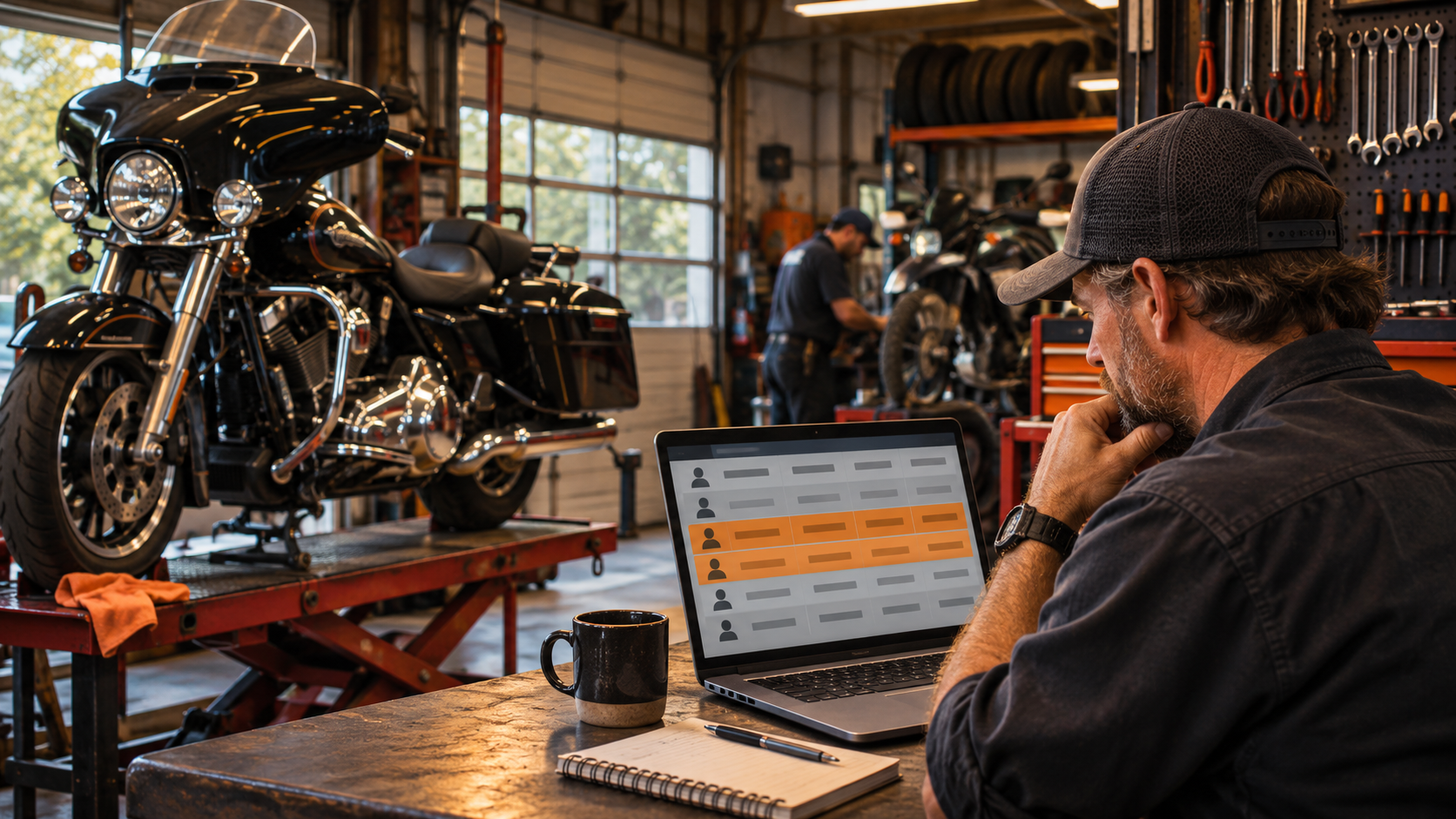
Motorcycle shop customer retention comes down to one habit: knowing which riders are due, which have gone quiet, and reaching out before they settle in somewhere else. Most independent shops already have the data in their invoices. They just never look at it as a list of people who could be back on the lift next month.
This is a guide for owners and service managers. It covers what "customer insights" actually means for a small shop, why most shops don't track them, and how to start this week with a spreadsheet and an hour.
What "customer insights" means for a small shop
Forget dashboards and buzzwords. For an independent motorcycle or powersports shop, customer insights means being able to answer four questions quickly:
- Who is overdue for service? The rider who came in for a spring service last April and hasn't been back is probably riding on old oil and worn tires right now.
- Who stopped coming in? Not the one-time tire mount from a guy passing through, but the regular who used to show up twice a season and hasn't been seen in 18 months.
- When do your people actually ride? Your commuters, your weekend cruiser crowd, your dirt and side-by-side families and your snowmobile owners all have different calendars. Your busy and dead months follow theirs.
- Who are your best customers? The small group that brings in a big share of your service revenue, buys the parts and gear, and sends their buddies your way.
If you can answer those four, you can fill the bay on purpose instead of waiting for the phone to ring.
Why returning riders are worth more than new ones
Every shop knows the feeling. You spend on ads, a rally booth or a sponsorship, and a few new faces trickle in. Meanwhile the riders who already trust you with their bikes drift off without anyone noticing.
The general business research points the same way. Harvard Business Review notes that, depending on the study and the industry, acquiring a new customer is somewhere between five and 25 times more expensive than keeping an existing one. That's a wide range, and nobody has nailed down a number for motorcycle shops specifically. Still, the direction is clear: a rider who already knows your shop costs you far less to bring back than a stranger costs to win.
Closer to home, Max Materne, a former powersports dealer and co-founder of Ownex, wrote in Powersports Business that in the dealership data he analyzed, customers often bought a unit and then disappeared after their first annual service. He put the average customer lifetime at just 1.1 years, and he also cites the finding that repeat customers spend three times more than one-time shoppers. That's one consultant's read of dealer data, not an industry census. But if you run a service department, it probably sounds familiar.
The point isn't the exact multiple. It's that your customer list is the cheapest revenue you have, and most of it is sitting idle.
Why most small shops don't track this
This isn't laziness. Independent shops are busy in a very specific way:
- The data is scattered. Some customers live in the POS, some in a DMS, some in a paper invoice book, and some only in the head of the service writer who left two years ago.
- Dealer CRMs are built for dealers. The big systems are designed around unit sales, OEM programs and multi-rooftop groups. For a two-bay independent, they're often too much software, too much money and too much setup.
- Spring eats the plan. The idea of "reaching out to old customers" comes up when it's slow. By the time anyone gets to it, the season has started, the bays are full, and the list goes back in the drawer.
- Nobody owns it. The techs are wrenching, the counter is ringing up parts, and the owner is doing everything else. Following up with lapsed riders ends up as nobody's job.
So the riders don't leave because of a bad experience. Most of them just drift. They forget, a buddy mentions another shop, or they do the oil change in the driveway "just this once." Without a list, you never see it happen.
How to start tracking customer insights without any tools
You don't need software to get started. You need a spreadsheet, your records and an honest hour. Here's how.
1. Pull everything into one list
Export what you can from your POS or shop software. Type in the rest from invoices if you have to. At minimum you want these columns:
- Name, email and phone
- Bike or machine (year, make, model)
- Date of last visit
- What was done on that visit (service, tires, repair, parts only)
- Rough total spent, if you can get it
Don't aim for perfect. A list of 300 customers with last-visit dates beats a perfect list you never finish.
2. Sort by last visit and bucket them
Sort by last-visit date, then group your customers:
- Active: in within the last 6 months
- Due: 6 to 12 months
- Quiet: 12 to 24 months
- Gone cold: more than 24 months
The "Due" and "Quiet" groups are where the money is. They still remember your name, and their bikes still need work.
3. Flag who is actually overdue for service
Last visit date only tells you so much. A rider who came in for a full service in May isn't in the same spot as one who came in for a tire plug. Compare what was done with the maintenance intervals in the owner's manual for that model and flag anyone who is likely past due on oil, tires, brakes or a valve check. Your techs will know the common ones by heart.
4. Map your season
Count visits by month for the last two or three years. You'll see your crunch and your dead stretch. Then plan around them: reminders go out before the rush so the work is booked in rather than piling up, and winter is for storage prep, tune-ups and project work. We covered the winter side in detail in how to fill empty service bays this winter.
5. Know your new-versus-returning mix
Each month, count how many service tickets came from first-time customers and how many from people who've been in before. If almost everything is first-timers, you're paying to refill a leaky bucket. If almost everything is regulars, you may need more new blood. Either way, now you know.
6. Reach out like a person, not a billboard
Pick one group, usually "Due" or "Quiet," and send a short, plain email from the shop. Mention the bike. Give a real reason to come in: spring service, a tire check before the first long ride, storage prep. Skip the "HUGE SALE" energy. Something like:
"Hey Mike, it's been a while since we had your Road Glide in. If it's due for a service before riding season, we've got openings in March. Reply here or call the shop."
You can also send riders something useful, like a guide on how to winterize a motorcycle. It keeps you in their inbox without asking for anything.
A legal note: marketing emails in the US fall under the CAN-SPAM Act, which requires things like an honest subject line, your physical address and a working unsubscribe option. The FTC's CAN-SPAM compliance guide for business lays it out in plain English.
7. Repeat monthly
Block out the same hour every month. Update the list, re-bucket, and send to the next group. The shops that win back riders aren't the ones with clever emails. They're the ones that actually keep at it.
The catch: doing this by hand gets old fast
All of the above works. It's also exactly the kind of work that slides once the season kicks in. Cleaning exports, sorting dates, writing emails and keeping track of who got what is a lot of admin for a shop that would rather be turning wrenches.
That's why we built Garage by Torque & Horse. If you'd rather see your quiet customers without building the spreadsheet yourself, you can run a free trial campaign there first.
How Garage handles it for you
Garage is a customer reactivation tool made for independent motorcycle and powersports shops. It isn't a full dealer CRM, and it isn't trying to be one. It does one job: bring riders you already have back through your door.
Here's how it works:
- Upload your customer list. Use the export from your POS or shop system, or the spreadsheet you started above.
- See your Insights. Garage shows you which customers have gone quiet and how long it has been since each one came in. Steps 1 and 2 from the section above, done for you.
- Send a done-for-you email campaign. Garage builds campaigns aimed at getting riders back in for service, so you don't have to write them from scratch.
- Pay per campaign. There's no long contract and no monthly software bill sitting there through the slow months. You pay when you send.
We're riders and garage people ourselves, and we built Garage around how small shops actually run: short-staffed, seasonal, and too busy in May to think about February's plan.
FAQ
What is a good customer retention strategy for a motorcycle shop?
Know who's due and who's gone quiet, then contact them on a regular schedule with a real reason to come in, such as seasonal service, tires or storage prep. Consistency matters more than clever offers. A monthly check of your customer list beats one big push a year.
How do I get old service customers to come back?
Start with riders who were last in 6 to 24 months ago. Send a short, personal email that mentions their bike and a specific service they're likely due for. Make booking easy by giving them a reply, a phone number or a link. Leave the discount out of the first message.
When should a motorcycle shop send service reminders?
Before demand peaks, not during it. Reach riders in the weeks leading up to your busy season so the work gets booked ahead of time, and again in the fall for storage and winter projects. Your own visit history by month will show you the right timing for your area.
Do I need a dealership CRM to track lapsed customers?
No. A spreadsheet with last-visit dates gets you most of the way. A dedicated tool like Garage simply saves the time of sorting, tracking and writing the campaigns yourself.
Try it on your own list
You already have the riders. You just need to see who's slipped away and give them a reason to come back. Start a free trial campaign at garage.torqueandhorse.com: one email to up to 100 of your customers, no card needed. Then see who shows up.